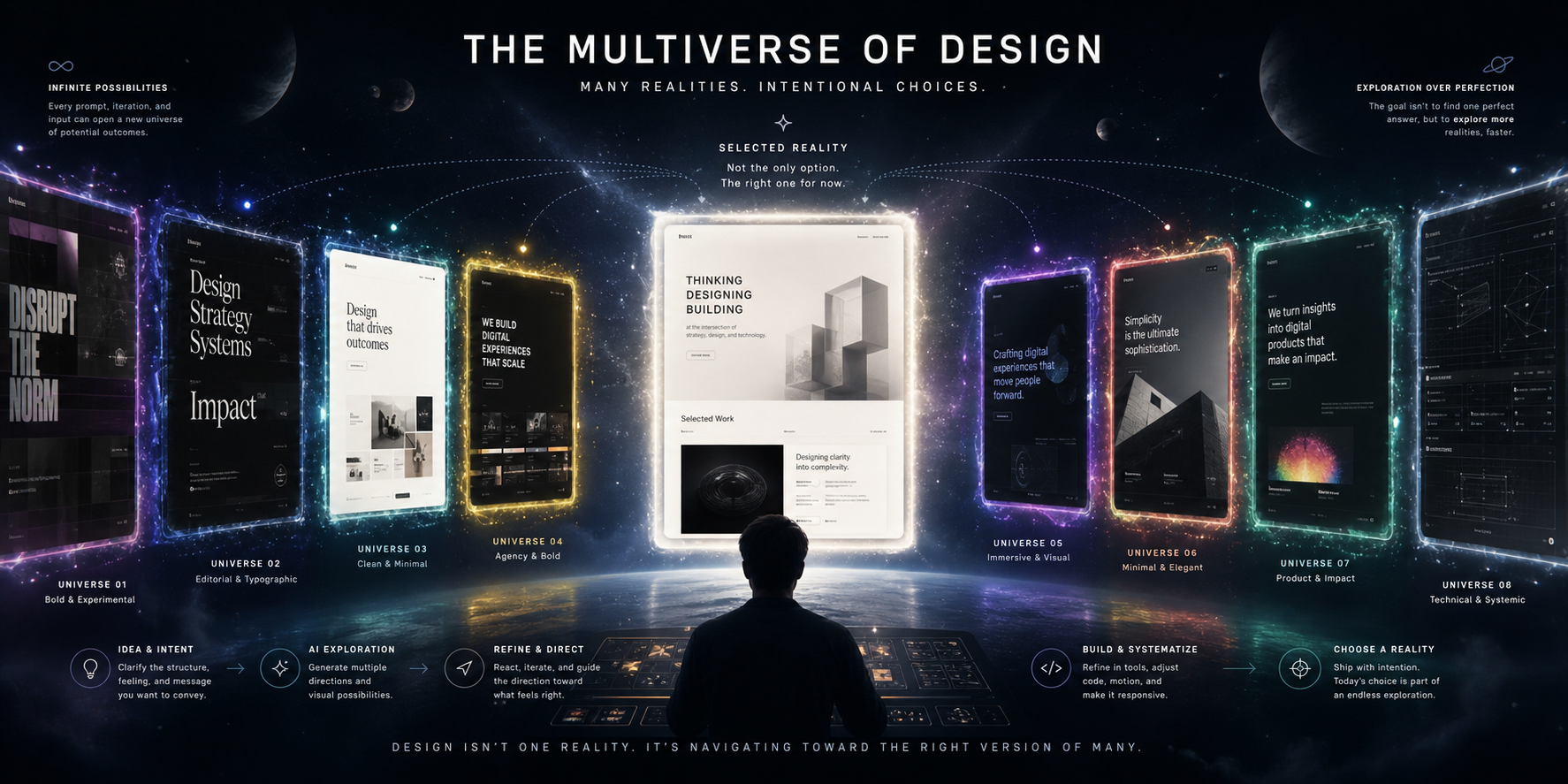
From Hand-Coded Perfection to Design Multiverses
How AI changed the way I build, think, and ship a portfolio
It was only about 4.5 years ago when I sat down at my laptop and hand-coded my portfolio in HTML and CSS.
At the time, I was obsessed with control.
Every spacing decision mattered. Every animation had to be timed precisely. I spent weeks refining a minimal, clean white layout—stripped of noise, stripped of emotion. It was, in my mind, the purest expression of craft: precise, intentional, and fully under my control.
That version of design felt like building a final artifact.
Then the process changed
This past month, I revisited my portfolio with a very different mindset.
Instead of opening a code editor and pushing pixels for hours, I started at a higher level:
- What is the structure of the experience?
- What feeling should the portfolio carry?
- What am I actually trying to communicate as a designer today?
With those inputs, I used Base44’s LLM system to generate a first version of the site.
And immediately, I ran into something interesting.
The output was competent—but familiar. A dark, agency-style layout. Big product shots. Bold type. It felt like a “default AI design studio template.”
Technically fine. But not me.
The shift: from output to direction
That first result wasn’t a failure—it was a baseline.
It gave me something concrete to react against.
From there, the design process became less about creation from scratch and more about direction:
- What if the landing page had more motion?
- What font pairings feel closer to how I think?
- How do I express both strategy and visual sensitivity, not just aesthetics?
Design stopped being about producing one perfect output, and started becoming about navigating between possible ones.
The constraint: control still matters
There was one issue.
Base44 didn’t give full access to the underlying code.
And for me, control isn’t just preference—it’s part of how I work.
So I pivoted.
I brought the generated visuals into Figma and began rebuilding.
Then I pushed further—feeding mockups into ChatGPT to generate working HTML/CSS.
And it worked.
Building the hybrid workflow
From there, the process became iterative and slightly messy in the best way.
- AI-generated structure
- Figma refinement
- Code regeneration
- Manual adjustments
Less like building. More like stitching.
The real constraint wasn’t design—it was content
The hardest part wasn’t layout or motion.
It was storytelling.
A lot of my past work is under NDA.
How do you show the mind behind the work when the work itself can’t be shown?
- decision-making
- iteration
- systems thinking
- product strategy
Stress testing reality
As the build progressed, responsiveness became the final layer of complexity.
Desktop designs rarely translate cleanly to mobile without rethinking structure. I’ve always found that transition to be where systems break.
This time, I used Claude to help refine breakpoints and flex behaviors, gradually turning a rigid desktop-first layout into something more fluid and adaptive.
What started as something stiff became more like a system that could breathe across contexts.
The final system (for now)
There are still imperfections.
For example, the cursor behavior is slightly inconsistent between sections—square on the homepage, rounded in case studies.
But I’ve started to appreciate that tension. It subtly signals a shift in context: from exploration to focused work.
Not everything has to be fully uniform to be intentional.
The insight
The biggest realization from this entire process wasn’t about tools or workflows. It was this:
Design output is not a single reality—it is one selection from a multiverse of possible realities.
AI doesn’t replace the designer’s role in that system.
AI expands how many realities we can test.
It expands the number of realities we can access, test, and iterate through in a fraction of the time.
What used to take weeks of manual refinement and uncertainty can now be explored in hours. Not to shortcut thinking—but to accelerate the feedback loop between idea and reality.
Closing thought
I used to think design was about building the “right” thing.
Now I think it’s about navigating toward the right version of many possible things.
Less time pushing pixels into certainty.
More time choosing between realities worth building.